
Roof Replacement & Metal Roofing Across Moreton Bay
Moreton Bay is not one roofing job. A weatherboard cottage at Woody Point, a 1975 brick-and-tile house at Bray Park and a 2005 estate home at North Lakes need three different conversations — and the salt that eats a roof at Scarborough barely registers at Wamuran.
Free Roof Inspection
Free written quote for Moreton Bay — no obligation, no surprises.
Roofing Services in Moreton Bay
We offer comprehensive metal roofing solutions for residential and commercial properties throughout Moreton Bay.
Roof Replacements
Full strip and re-sheet in genuine Colorbond® steel, with battens and tie-downs brought up to current requirements.
New Roof Installations
New builds and extensions, working to your builder’s programme.
Roof Repairs
Leaks, storm and hail damage, failed fixings, flashings and ridge capping.
Asbestos Roof Replacement
Licensed Class-B removal and clearance coordinated, then your new Colorbond® roof — one contract.
Insulation Upgrades
Anticon® blanket and sarking, fitted while the sheets are off and the cavity is open.
Gutters & Downpipes
Replaced with the roof so the whole water path is renewed at once.
Skylights & Whirlybirds
Natural light and roof-space ventilation, flashed properly into the new sheeting.
Recent Projects
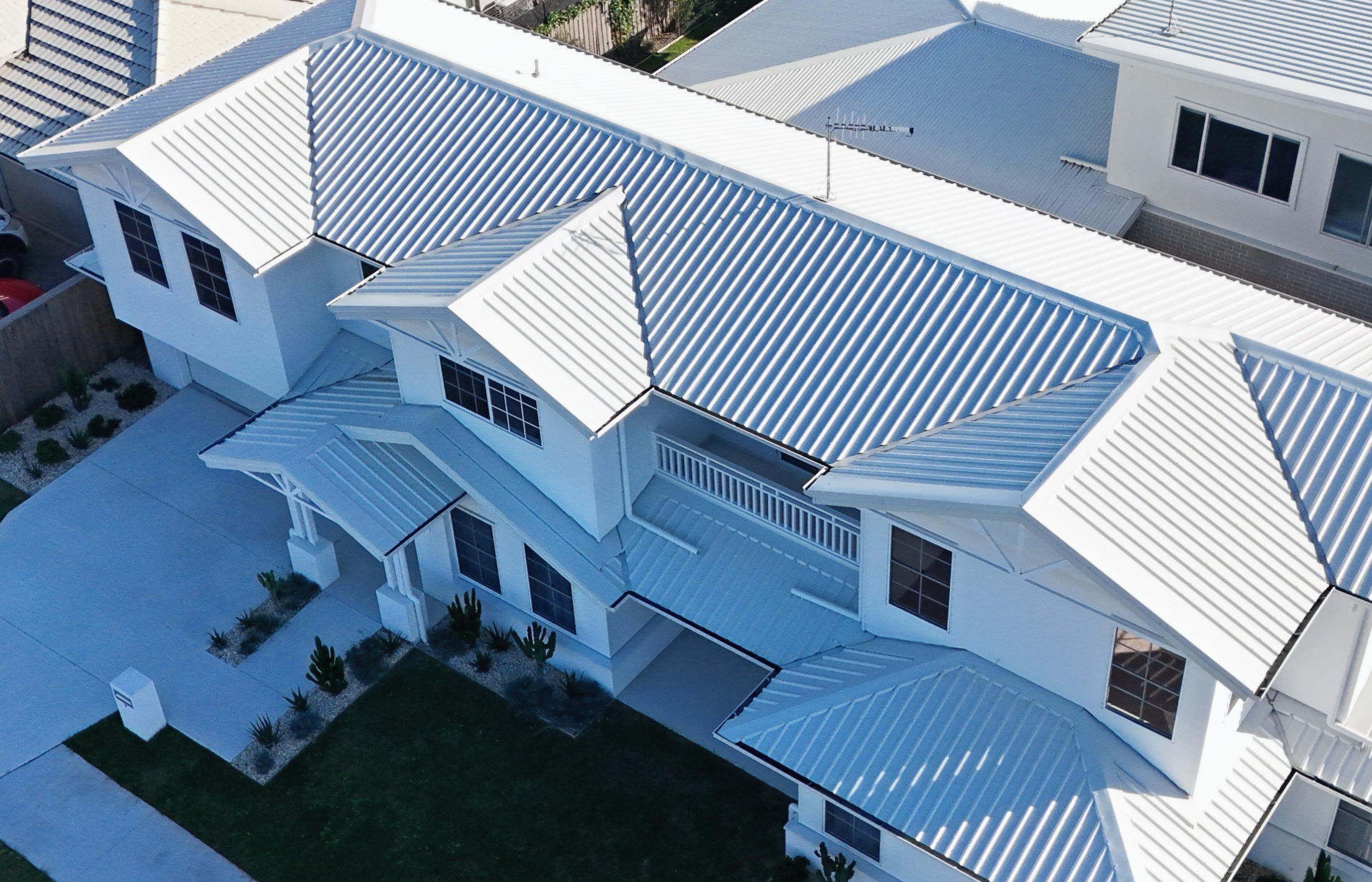

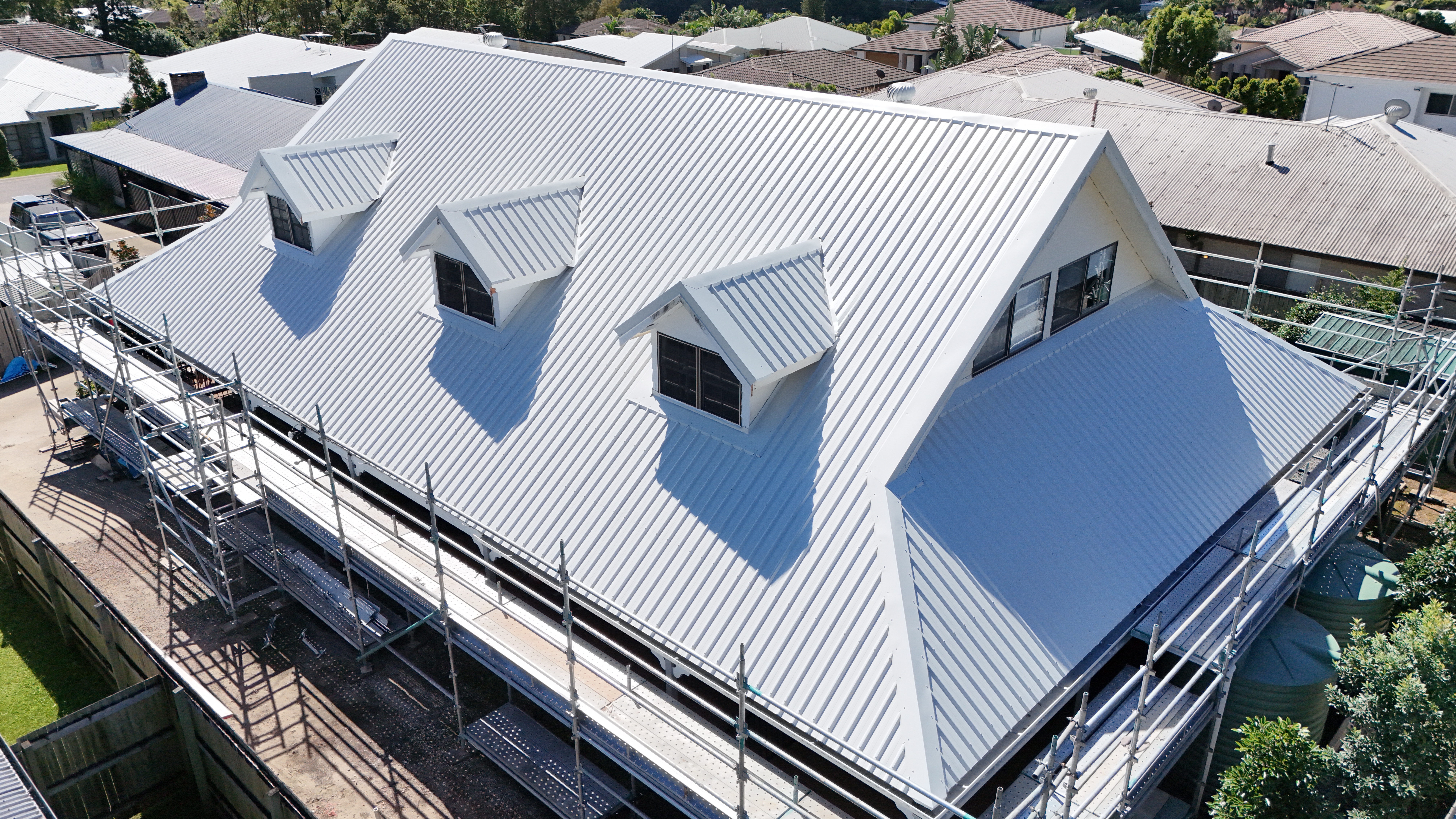

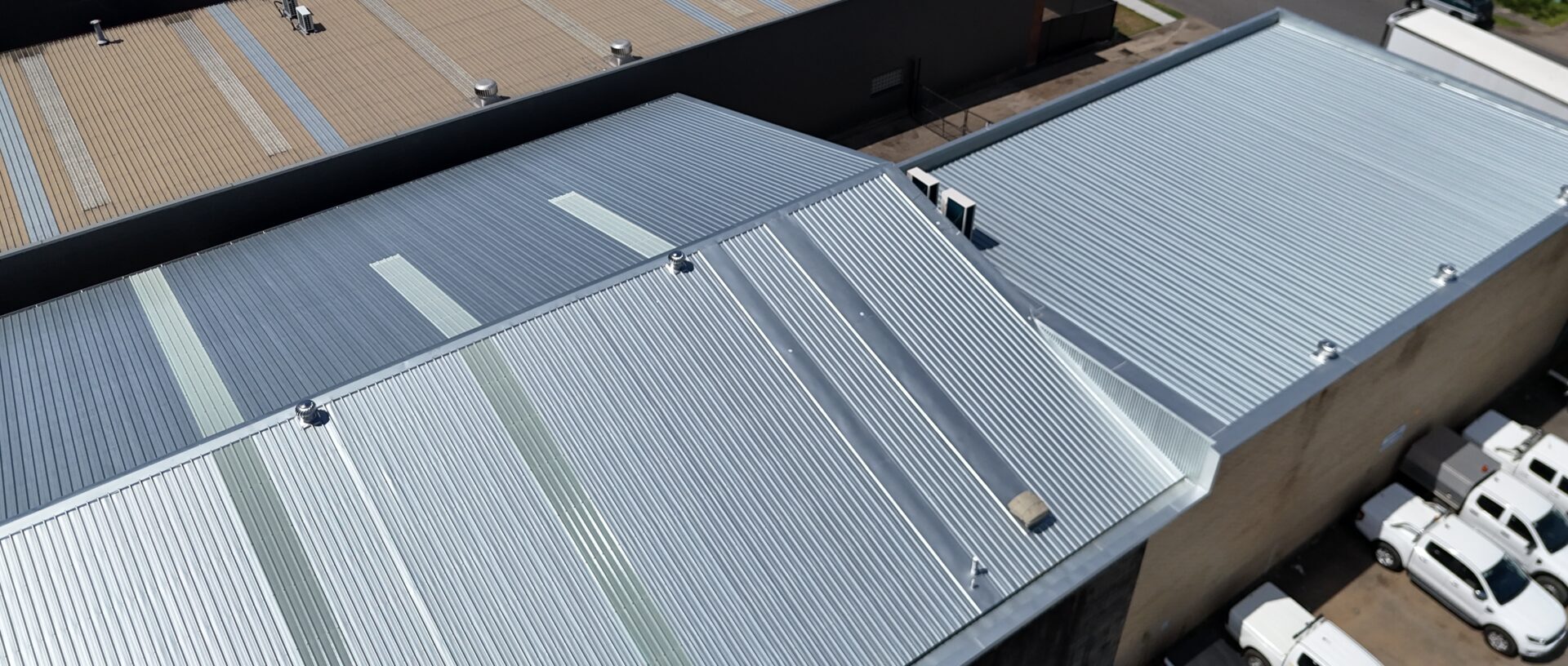
A selection of our precision roof installations across Moreton Bay.
Three former shires, three different roof stocks
The local government area was put together in 2008 out of three separate councils — Caboolture Shire, Pine Rivers Shire and Redcliffe City. Locals still talk in those three areas, and so do the roofs. It is the single most useful thing to know before you ring anyone for a price, because it tells you what job you are probably buying.
The Redcliffe peninsula had no direct road link to Brisbane until the Hornibrook crossing opened in 1935, and it grew first as weekenders and holiday cottages before it became permanent suburbia. The older stock at Redcliffe, Margate, Woody Point, Clontarf and Scarborough is mostly modest, low-set timber and fibro with simple roof planes — usually re-sheeted at least once already, and often carrying a later sleepout, patio or carport whose roof does not match the main one. Those junctions between old and added roof are where we find most of the leaks.
The Pine Rivers belt is a different animal. Strathpine, Bray Park, Lawnton, Petrie, Kallangur, Arana Hills, Ferny Hills, Everton Hills and Albany Creek were built out largely from the mid-1960s through the mid-1980s, as Brisbane's growth crossed the old shire line and farms were subdivided. That era of Australian project housing was overwhelmingly brick veneer with a concrete tile roof. Those roofs are now forty to sixty years old, which is the window in which a concrete tile roof reaches its decision point — and tile-to-metal conversion is the work this business is built around.
The Caboolture side boomed roughly fifteen years later. Morayfield, Deception Bay, Burpengary, Narangba, Bellmere and Upper Caboolture filled in through the 1980s and 1990s, which straddles the changeover — plenty of concrete tile, but metal sheeting increasingly common on the later estates. So the northern belt is genuinely mixed, and what you have there is worth checking rather than assuming.
Then there is the master-planned north — North Lakes, Mango Hill, Griffin, Murrumba Downs — built from the late 1990s onward. Those homes are structurally past the asbestos era, and most will be a long way from the end of a roof's life. The honest work there is repair, insulation, ventilation and guttering, not replacement, and we would rather tell you that on the driveway than quote you a re-roof you do not need.
Salt here is a bay problem, not a surf problem
Of the regions we work in, Moreton Bay is the only one whose saltwater frontage is mostly sheltered water. Ipswich is inland. The Gold Coast is open surf. Moreton Bay is a bay and a passage — which is a different exposure, and it deserves a different answer.
Airborne salt is generated mostly by breaking waves aerosolising seawater. Moreton and North Stradbroke shelter the bay proper, and Bribie Island shelters Pumicestone Passage. So Bongaree, Banksia Beach, Sandstone Point, Toorbul, Beachmere, Godwin Beach, Deception Bay and the whole Redcliffe peninsula sit on calm or wind-driven salt water rather than surf. Woorim, a few kilometres away on the ocean side of the same island as Bongaree, does not. Two suburbs, one island, two different specifications — which is why the right answer for your address is the environment category currently published for that site, checked when we measure up, and not a distance rule imported from a surf coast.
The peninsula has a quirk worth naming. Water sits on three sides of it — the bay to the east and north, Bramble Bay and Hays Inlet to the west and south — so every roof at Redcliffe, Scarborough, Newport, Margate, Woody Point, Clontarf and Kippa-Ring has a seaward elevation whichever way the house is turned, and corrosion generally shows on that side first. Which way does your roof face is a real inspection question at Margate. It is not much of one at Warner.
Sheltered water is the trap here. A surf-coast rule of thumb tells someone at Bongaree or Godwin Beach they are far enough from breaking waves not to worry, and the sheeting usually is fine — the screws are not. Roofing screws are graded for corrosion resistance under AS 3566, Class 4 is the marine grade and Class 3 is the general grade that is perfectly adequate inland. On the bay side it is the fastener that goes first: rust bleeding out of every screw head and staining down sheeting that is otherwise sound. It is invisible in a quote unless someone spells it out, so ask which class is being fixed to your roof.
The peninsula's three-sided exposure has a second consequence. Salt does not accumulate where the rain washes it off — it builds up on the surfaces rain never reaches, so on a Clontarf or Woody Point roof the undersides of eaves, the backs of flashings, the gutters and the wall-to-roof junctions are collecting salt while the open planes look clean. BlueScope's warranty terms include maintenance requirements for exactly those unwashed surfaces, so check the current terms for your product and site. Reusing old lead flashings or leaving an old copper pipe discharging onto new sheet sets up the same problem faster — and it runs faster at Clontarf than it ever would at Wamuran.
The storms arrive from the opposite direction to the salt
Dayboro, Samford, Woodford, Wamuran and D'Aguilar are in the path first, and often while the cell is at its most vigorous. South East Queensland storms build over the ranges through the afternoon and track east toward the coast, which puts the western half of this local government area in front of them. Moreton Bay is the only one of the five regions we work in with a range along one edge and open water along the other, and the two halves get very different weather out of the same storm.
Here is the part almost nobody mentions. The everyday salt-bearing breeze comes off the water in the eastern quadrant. The destructive gust in a thunderstorm is a downburst, and it usually arrives from roughly the opposite direction, out of the west ahead of the storm. So the roof planes that corrode first are not the planes that see peak uplift. Corrosion detailing and wind fixing are two separate problems on the same roof, and on the peninsula they load opposite elevations.
Shielding is the variable that changes most from one Moreton Bay house to the next. An unshielded bayfront at Deception Bay or Beachmere presents its roof edge straight to the water with nothing upwind to break the flow. A house in the middle of a Strathpine block has two streets of other houses doing that job for it. Same region, same storm, different fixing schedule.
Three situations in this region routinely push a site up a wind classification: an open acreage lot at Wamuran with nothing around it, a ridge-top block above Samford where the terrain accelerates the flow, and an exposed bayfront. What that changes on the roof is concrete — batten and purlin spacing, screws into every rib rather than alternate ribs at ends and perimeters, and tie-down continuity from sheet to batten to rafter to the frame below. It is also a legitimate reason two quotes on the same street can differ, because classification is a property fact rather than a suburb fact.
Because the tile belt from the first section runs right through the middle of this region, most post-hail calls across Moreton Bay are tile calls rather than metal ones. Hail cracks and chips concrete and terracotta, and the leak that follows often does not show up inside for weeks. It dents Colorbond® rather than shattering it, and short of a coating breach the damage is usually cosmetic — on a metal roof what actually gets replaced after a hail run is the plastic, skylight domes and whirlybird cowls, plus gutters, where a full gutter takes the impact load.
Which council, and what actually needs approving
The council is the City of Moreton Bay, renamed from Moreton Bay Regional Council in 2023. You will still see the older name on plenty of council documents and maps, so do not assume you have landed on the wrong council when it turns up.
One piece of Brisbane advice gets copied onto Moreton Bay pages constantly and it does not apply here. Brisbane's pre-1947 traditional building character overlay is an instrument of Brisbane City Plan, and a planning scheme only has effect inside its own local government area. A pre-war cottage at Woody Point or in the old Caboolture township is not under it. Moreton Bay's scheme has its own heritage and landscape character overlay, applied to mapped areas and listed places rather than as a blanket age-based rule, and state heritage listing sits over the top of all of it as a separate layer.
The boundary through the Hills District catches people out too. Arana Hills, Ferny Hills, Everton Hills, Bunya, Albany Creek and Eatons Hill are in Moreton Bay, despite postcodes that read like northside Brisbane, while the adjoining suburbs on the other side are Brisbane City. Houses on opposite sides of the same street sit under different planning schemes and different overlay maps — which is worth knowing before you rely on what a neighbour was told about their place.
There are two approvals in Queensland, not one, and they come from different places. Building approval is issued by a private building certifier under the building legislation. Planning or development approval is assessed by the council against its planning scheme. A re-roof can need one, both or neither, and the certifier is the person who decides — not us, and not the council's front counter. Ask that question before the job is booked rather than mid-tear-off: look your address up on the council's planning map, confirm the building side with a certifier, and treat what is on this page as a starting point for the right questions rather than as planning advice.
Asbestos: the date that matters is when the roof was last done, not when the house was built
This is the question that decides the shape of a re-roof on the region's older stock, and the usual version of it is asked wrong. The trigger is whether the house was built or last re-roofed before 1986. A 1930s Redcliffe cottage that was re-sheeted in 1968 has asbestos cement on it even though nobody thinks of it as a fibro house. A 1975 tiled house at Bray Park might have it only on the 1980 patio. Neither is a call to make from the ground — it gets tested, and our asbestos page covers how that works.
Where it turns up across Moreton Bay follows the settlement pattern rather than the map. It concentrates in the older peninsula stock and the pre-1980s Bribie core; on the low-lying bay and passage flats at Beachmere, Toorbul, Godwin Beach and Donnybrook; through the rural west and north — Wamuran, Woodford, Dayboro, D'Aguilar, Elimbah and Upper Caboolture — where sheds and outbuildings are common; and on ancillary structures everywhere, meaning garages, carports, patios and verandah roofs. It is less likely to be the main house roof across the big brick-and-tile estate belts, because that era used concrete tile. That is reasoning from build eras, not a survey, so it is a starting assumption rather than a finding.
Under Queensland work health and safety law, removal of more than 10 square metres of bonded asbestos requires a licensed removalist, and asbestos cement roof sheeting is Class-B work. Below that threshold the rules for a householder are narrow and conditional, and a roof is the worst place to test them — sheeting is brittle, elevated and easy to break. Treat roof sheeting as a job for a licensed removalist regardless of area.
We do not remove asbestos ourselves, and you should be wary of any roofer who says they do it in-house without naming the licence. What we do is manage the project: we coordinate the assessor, the licensed Class-B removalist, disposal at a landfill licensed to accept asbestos waste, the clearance inspection and clearance certificate from a licensed assessor, and our own crew installing the new Colorbond® roof — one contract and one point of contact. It also means an asbestos re-roof cannot start next Monday the way a straight metal re-sheet can, because licensed removal has to be notified to the workplace health and safety regulator before work begins.
Heat, condensation and the one cheap moment to deal with both
The region splits thermally as clearly as it splits by salt. Bayside afternoons at Redcliffe, Scarborough, Woody Point and the Bribie suburbs are moderated by the sea breeze. Caboolture, Morayfield, Narangba, Bellmere, Wamuran, Woodford and Dayboro sit far enough from the water to run hotter on a summer afternoon and colder on a clear winter night. The inland half carries the larger daily swing in both seasons — which is a fair trade for not paying the salt penalty.
That swing does two things to a metal roof. Steel expands and contracts at roughly twelve millionths of its length for every degree, so a twenty-metre sheet run, cycling through the sort of surface-temperature swing a steel roof sees between a cold night and a hot afternoon — call it sixty degrees — moves on the order of fourteen millimetres over its length. It is arithmetic anyone can redo. Long runs need that movement allowed for, and it is why fasteners work loose and washers perish on long runs well before anything happens to the sheeting itself. Colour choice carries a real penalty out at Wamuran or Bellmere and almost none at Scarborough, where the sea breeze is already doing the work.
The second thing is condensation, and it is not really a bayside problem here. On clear, still nights the sheet radiates heat to the sky and can drop below dew point, and moisture forms on its underside. That is an inland-valley pattern — Samford Valley, Dayboro, the upper Pine and Caboolture river country, and around Woodford and Wamuran — where overnight cooling is strongest. Sarking and Anticon® do as much for that as they do for heat, and because both are installed over the battens and under the sheeting, the inland half of the region is where that decision has to be made before the sheets go on. Retrofit later and you pay for roof access twice.
The Moreton Bay suburbs we cover
The bay foreshore and the Redcliffe peninsula: Redcliffe, Scarborough, Newport, Margate, Woody Point, Clontarf, Kippa-Ring, Rothwell, Deception Bay, Beachmere and Godwin Beach. This is the only cluster where the water sits on more than one side of the house — bay to the east and north, Bramble Bay and Hays Inlet to the west and south — so there is no landward elevation to hide a cheap detail on.
Bribie Island and the Pumicestone Passage shore: Bribie Island, Bongaree, Woorim, Banksia Beach, Sandstone Point, Ningi, Toorbul and Donnybrook. Sheltered passage water on the western side, open ocean at Woorim, and a pre-1980s island core that is squarely in asbestos territory alongside much later estate development.
The Pine Rivers and North Lakes corridor: North Lakes, Mango Hill, Murrumba Downs, Griffin, Kallangur, Dakabin, Petrie, Lawnton, Strathpine, Bray Park, Brendale, Warner, Cashmere, Joyner, Albany Creek, Eatons Hill, Arana Hills, Ferny Hills, Everton Hills and Bunya. Concrete tile through the older half and tile-to-metal conversions; repairs, insulation, ventilation and guttering through the newer estates.
Caboolture and the north-west hinterland: Caboolture, Caboolture South, Upper Caboolture, Morayfield, Burpengary, Burpengary East, Narangba, Bellmere, Elimbah, Wamuran, Woodford, D'Aguilar, Dayboro, Samford Village and Samford Valley. Mixed 1980s and 1990s estate stock through the middle, and acreage, sheds and long-span outbuildings out toward the range.
Each suburb has its own page with local detail, and the full five-region list is on our locations page. If your street is not named on one of them, ring us anyway — the list is how we organise the site, not a fence.
What you get in writing before anyone gets on your roof
Ascend Roofing Group is family owned and operated, QBCC licensed (Lic. 15600031), with more than fourteen years on the tools and over 1,200 roofs completed. We work across Brisbane, the Gold Coast, Logan, Ipswich and Moreton Bay. That licence number is the useful part: you can put it into the QBCC licence search yourself before you ring anybody — ours, or the next roofer's.
The assessment is on site and free, with no call-out fee, and what comes back is a clear, itemised quote with a fixed price. No hidden fees and no pressure. Our hours are Monday to Friday, 7:30am to 3:30pm, on 0419 098 049.
If you are collecting three quotes — and for a re-roof you should — the comparison only works if each one itemises the same list: sheet profile, steel grade and base metal thickness, fastener class, battens, tie-downs, sarking or insulation, flashings and valleys, gutters, and removal and disposal. An asbestos roof adds a licensed removalist, a notification period and a clearance certificate on top of that. Two quotes that differ by thousands almost always differ somewhere on that list rather than on labour. Ask for it in writing and the decision becomes possible to make.
We are not a twenty-four-hour operation and will not pretend otherwise — active leaks are prioritised and we aim to attend within two to five business days across the region, often sooner. If water is coming in right now, contain it inside, stay off the roof, and photograph the damage with the date on it before anything is moved.
And if what you are actually weighing up is whether yours is a restoration job or a replacement job, that is a real question rather than a sales fork. We have written it up as a decision you can make on the evidence.
Why Choose Ascend Roofing?
Local Knowledge
We know Moreton Bay and the Moreton Bay climate well, ensuring your roof is built to withstand local conditions.
Expert Craftsmanship
Our team brings decades of combined experience. Every roof is installed with precision, attention to detail, and pride.
Transparent Pricing
No hidden costs. We provide clear, detailed quotes upfront for your Moreton Bay roofing project.
Reliable Service
As a family business, we're invested in our community. We show up on time and deliver on our promises.
Meet the Team
The dedicated professionals serving Moreton Bay.
Steve
Director14+ years of industry experience leading Ascend Roofing Group with hands-on expertise and a commitment to quality.
Jyett
DirectorCo-leading Ascend Roofing Group, Jyett brings extensive expertise and a vision for delivering exceptional roofing solutions.
Jade
Head of AccountsKeeping the business running smoothly, Jade manages all financial operations and administrative oversight.
Emily
Scheduling & Client RelationsYour first point of contact. Emily keeps jobs on schedule and ensures a seamless customer experience.
Moreton Bay roofing questions
What homeowners across Moreton Bay ask us most.
All 54 we list, from the Redcliffe peninsula and the bay foreshore across to Bribie Island and Pumicestone Passage, down the Pine Rivers and North Lakes corridor, and north-west through Caboolture to the hinterland at Woodford, Dayboro and Samford. Each has its own page with local detail. We are not a Moreton Bay-only business — we also work across Brisbane, the Gold Coast, Logan and Ipswich — but this region is a distinct service area rather than an add-on, and the specifications genuinely change across it. If your street is not on the list, ring us on 0419 098 049 and ask.
Yes, and tile-to-metal replacement is our specialty. The reason it comes up so often in this region is building history: the Pine Rivers belt and the older Caboolture estates were built in the era of brick veneer with concrete tile, so those roofs reach a decision point together. Pitch is never the obstacle. Tiles are laid at a minimum of 15 degrees under the tiling standard, while corrugated steel goes down to 5 degrees and some profiles lower, so any tiled roof is already well above what metal needs. What actually matters is underneath. With the tiles off, the frame is visible for the first time in decades — rotten or undersized battens get replaced and tie-downs are upgraded so the new roof is fixed to the structure, not just to the battens. Anyone offering to lay metal over your tiles is skipping the part that keeps the roof on.
Not automatically, and Bribie is the clearest illustration of why. Bongaree, Banksia Beach and Sandstone Point sit on Pumicestone Passage — sheltered water, where salt comes off wind-driven chop rather than breaking surf. Woorim is a few kilometres away on the ocean side of the same island. Where a site classifies as a marine environment, the specification is Colorbond® Ultra with its enhanced salt-spray resistance, and roofing screws are graded under AS 3566 with Class 4 as the marine grade. Redcliffe then adds a geometry the island does not have: water on three sides, so a peninsula roof has a seaward elevation whichever way the house is turned. We check the published environment category for your actual address when we measure up rather than working off a postcode.
Moreton Bay, for every suburb on our list. Arana Hills, Ferny Hills, Everton Hills, Bunya, Albany Creek and Eatons Hill are in the City of Moreton Bay despite postcodes that read like northside Brisbane, and the adjoining suburbs across the boundary are Brisbane City. It matters more than it sounds. Brisbane's pre-1947 traditional building character overlay is a Brisbane City Plan instrument and has no effect on your side of the line; Moreton Bay has its own scheme with its own heritage and landscape character overlay covering mapped areas and listed places. Separately from planning, building approval comes from a private building certifier — a re-roof can need planning approval, building approval, both or neither, and the certifier is the one who decides. Look the address up on the council's planning map and confirm the building side with a certifier.
Because they are not actually of similar age, and they are not made of the same thing. Strathpine, Bray Park, Lawnton, Kallangur, Arana Hills and Albany Creek were built out from the mid-1960s to the mid-1980s in brick veneer with concrete tile, so those roofs are forty to sixty years old and heading for replacement together — usually tile-to-metal. North Lakes, Mango Hill, Griffin and Murrumba Downs were built from the late 1990s onward, and most of those roofs are a long way from the end of their life. The honest work up there is repair, insulation, ventilation and guttering, and we would rather say so on the driveway than quote a re-roof nobody needs.
Follow the settlement pattern rather than the map. The trigger is whether the house was built or last re-roofed before 1986 — and that second half is the part people miss, because a 1930s peninsula cottage re-sheeted in the 1960s has asbestos cement on it. Across this region it concentrates in the older Redcliffe peninsula stock and the pre-1980s Bribie core, on the bay and passage flats at Beachmere, Toorbul, Godwin Beach and Donnybrook, through the rural west and north where sheds and outbuildings are common, and on ancillary structures everywhere — garages, carports, patios and verandah roofs. It is less likely to be the main house roof across the brick-and-tile estate belts, because that era used concrete tile. That is reasoning from build eras rather than a survey, so treat it as a starting assumption and have it tested. Do not cut, drill, sand or pressure-wash it to find out, and see our asbestos page for how the removal and clearance process runs.
Yes. New roof installations are a distinct part of what we do, and the two cluster differently across this region: the master-planned north and the newer estates are where extensions and new installs make sense, while the older Pine Rivers and peninsula stock is replacement country. A new install is a different brief — it is programmed around lock-up, the sheeting profile and fixing schedule follow the frame and the site's wind classification, and sarking or Anticon® has to be decided before the sheets go on rather than after. Talk to us at the plans stage rather than the week you need the roof on.
Get a Quote in Moreton Bay
Ready to start your roofing project in Moreton Bay? Get in touch for a free, no-obligation quote.
Send Us a Message
Nearby Suburbs We Service
We also provide premium Colorbond® roofing to these nearby areas.