
Metal Roofing in Ipswich
Ipswich is the only one of our five service regions with no saltwater frontage at all. No surf, no estuary, no bay — just an inland valley on the Bremer, forty-odd kilometres west of the coast, where summers run hotter and the corrosion story is completely different to the one we tell on the Gold Coast. That changes what a metal roof here actually needs. We install and repair Colorbond® steel roofs across the whole Ipswich region — the old timber-and-iron streets around the CBD, the post-war corridor out through Booval and Redbank, and the new estates at Ripley and Springfield.
Free Roof Inspection
Free written quote for Ipswich — no obligation, no surprises.
Roofing Services in Ipswich
We offer comprehensive metal roofing solutions for residential and commercial properties throughout Ipswich.
Roof Replacements
Full strip and re-sheet in genuine Colorbond® steel, with battens and tie-downs brought up to current requirements.
New Roof Installations
New builds and extensions, working to your builder’s programme.
Roof Repairs
Leaks, storm and hail damage, failed fixings, flashings and ridge capping.
Asbestos Roof Replacement
Licensed Class-B removal and clearance coordinated, then your new Colorbond® roof — one contract.
Insulation Upgrades
Anticon® blanket and sarking, fitted while the sheets are off and the cavity is open.
Gutters & Downpipes
Replaced with the roof so the whole water path is renewed at once.
Skylights & Whirlybirds
Natural light and roof-space ventilation, flashed properly into the new sheeting.
Recent Projects
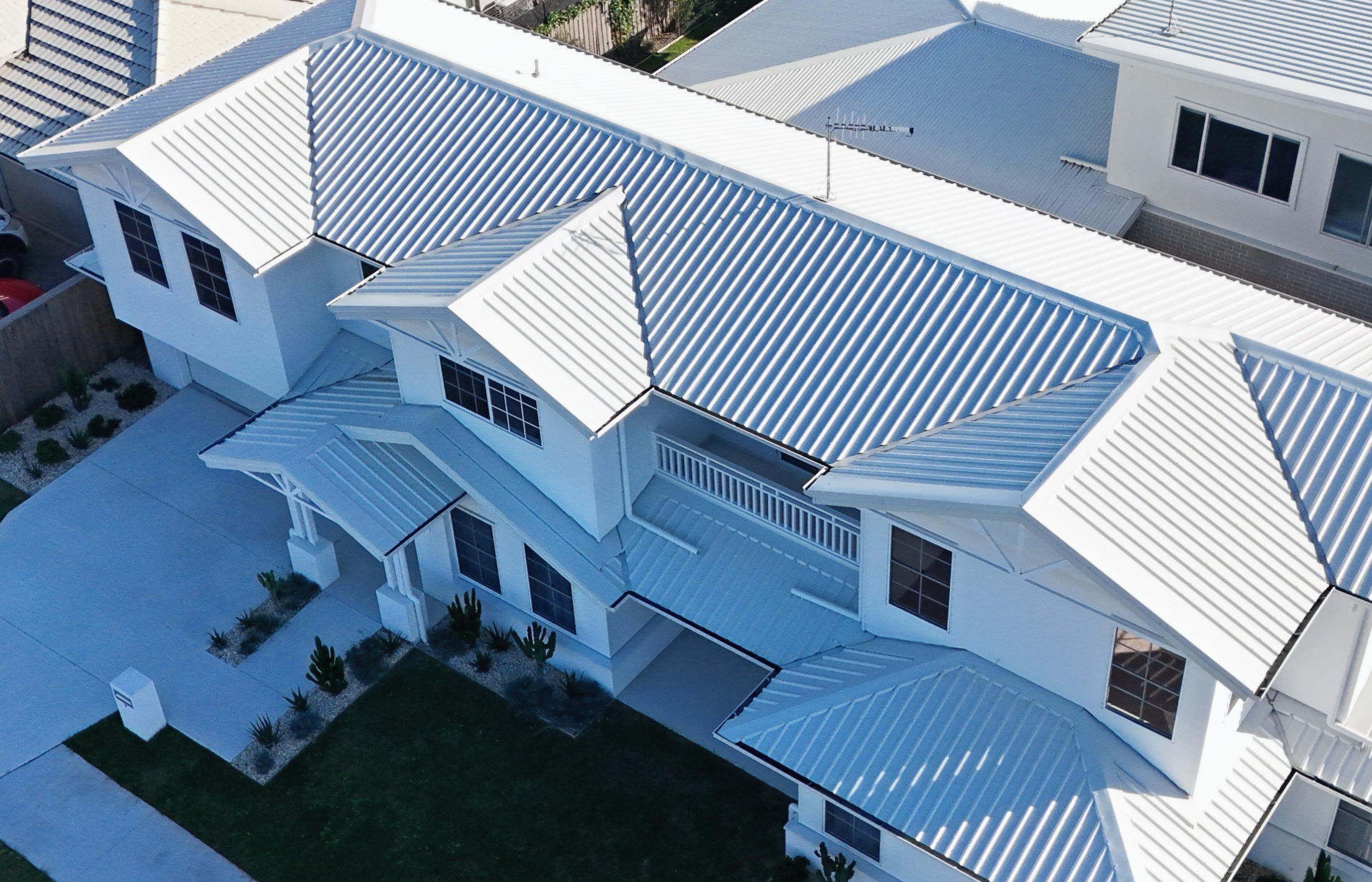

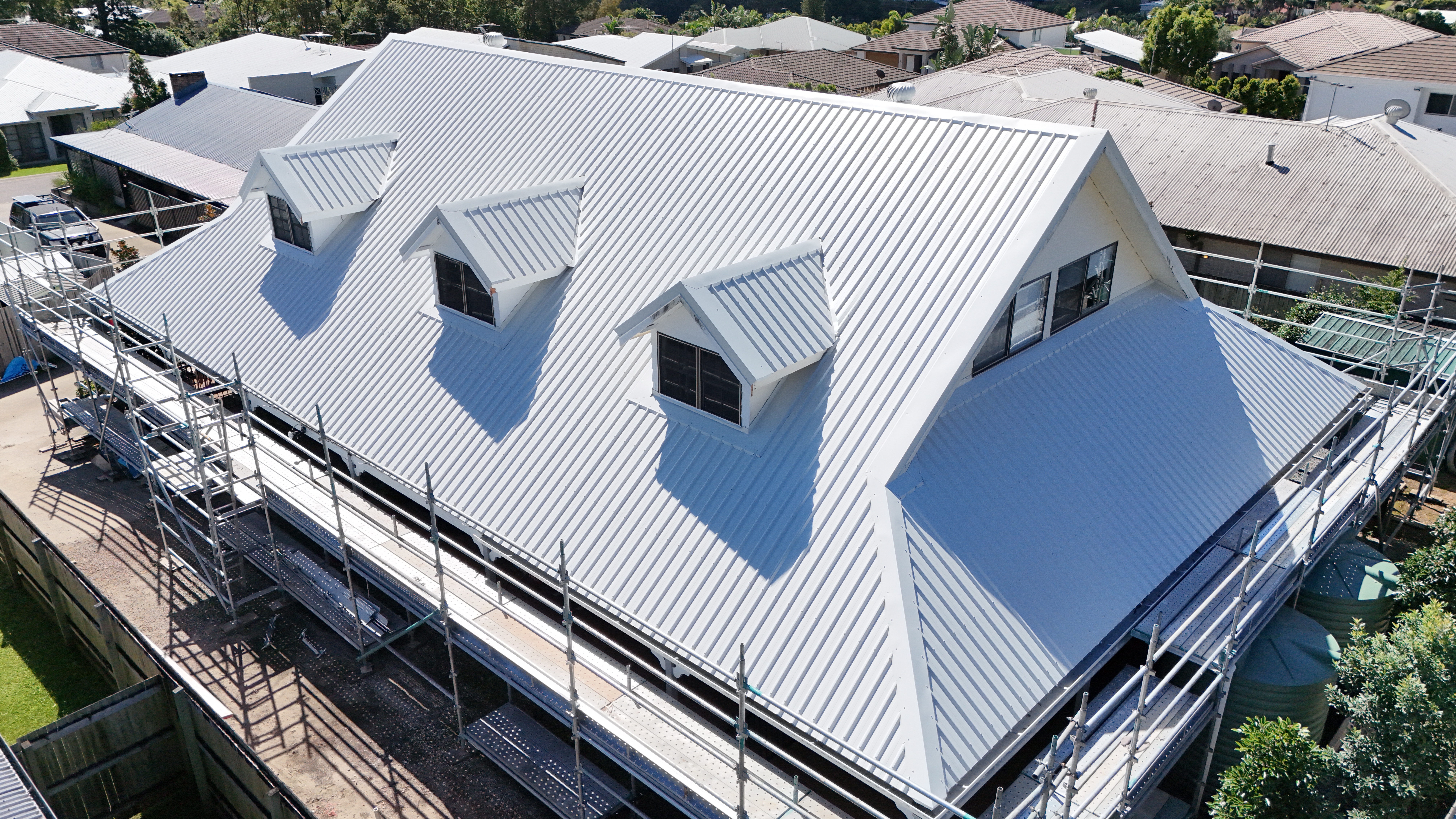

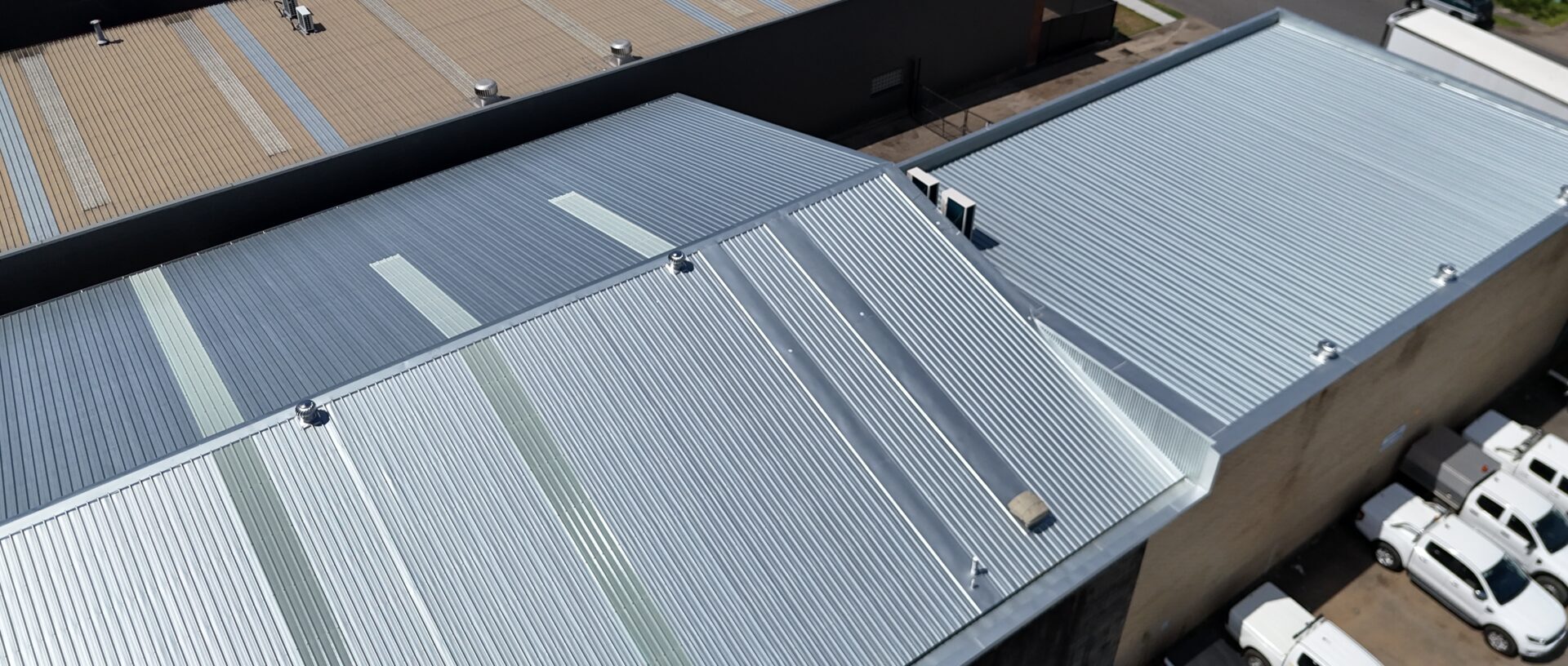
A selection of our precision roof installations across Ipswich.
Ipswich is inland, and the specification should say so
The Gold Coast fronts the ocean. Moreton Bay and the Wynnum–Manly side of Brisbane front the bay. Logan reaches tidal water at the river mouths. Ipswich touches none of it, and that single geographic fact settles a specification question that costs real money on the coast.
Our own rule for Colorbond® Ultra is that it belongs within about a kilometre of surf, estuary or tidal water — using standard Colorbond® in a marine zone voids the warranty. Ipswich clears that threshold by tens of kilometres, so standard Colorbond® is normally the correct steel here, and we would rather tell you that than quote you a coastal product your site cannot use. We still confirm the environment on site, because specification follows the address, not the postcode.
Inland does not mean maintenance-free, though, and this is the part homeowners get backwards. The corrosion driver in Ipswich is not salt — it is dust and condensation. Airborne dust settles in the parts of a roof that rain never washes: under eaves, the underside of gutters, behind parapets, under solar arrays. Heavy overnight dew and river-flat fog wet that deposit, and corrosion starts there. Washing those sheltered areas is the maintenance that actually matters on an inland roof, and there is more on how in the FAQs below.
The other consequence of being inland is heat. Without the north-easterly sea breeze that moderates the bayside and the coast, Ipswich summer days run hotter and the swing between afternoon and dawn is wider. Roof-cavity heat load, not salt, is the climate problem here, which makes insulation and ventilation a stronger proposition in Ipswich than at Wynnum. Anticon® blanket comes as standard on a new install; on a re-roof, adding or upgrading insulation is only cheap while the sheets are off, because it goes under them.
Four building eras in one council area
"Ipswich" is not one roofing market. It is Queensland's oldest provincial city wrapped around some of the newest master-planned housing in the country, and the job that turns up at the door depends almost entirely on which of those you live in.
The old core — Woodend, Sadliers Crossing, Coalfalls, One Mile, Churchill, and East, North and West Ipswich — is largely pre-war timber housing. That stock was characteristically sheeted in corrugated iron rather than tiled. So in those streets the common job is metal to metal, not a tile conversion: tired short-sheet galvanised iron coming off, long-run Colorbond® going on. Those roofs also tend to be steeply pitched, which changes the access and safety scope of the job, and is part of why a Queenslander re-roof does not price the same as a single-storey estate roof.
The corridor that filled in after the war — Booval, Bundamba, Silkstone, Blackstone, Ebbw Vale, Dinmore, Riverview, Redbank and Goodna — saw much of its housing built in fibro rather than the traditional timber and tin. That is the asbestos conversation, and it has its own section below.
The brick-and-tile belt came next, broadly the late 1960s through the 1990s. Those concrete tile roofs are now at the age where the repair-versus-replace question gets asked seriously, and this is where genuine tile-to-metal conversion work sits.
Then there are the growth corridors — Springfield, Springfield Central, Springfield Lakes, Brookwater, Augustine Heights, Spring Mountain, and Ripley, South Ripley and Deebing Heights. Those roofs are recent, and the work out there is more often repair than replacement: storm and hail damage, gutters and downpipes, insulation and ventilation retrofit, and new-build installation working to a builder's or owner-builder's programme.
One more slice worth naming: the acreage and rural-residential fringe out west and along the river — Pine Mountain, Walloon, Blacksoil, Muirlea, Barellan Point and Chuwar. On those properties the roof is often also the drinking-water catchment. Colorbond® and Zincalume® steel are accepted materials for a drinking-water catchment under Australian public-health guidance; lead flashing is not, and a strip-and-re-sheet is the right moment to remove any that is up there — ask us to price it in. Keeping construction debris out of the tank during the job is part of the scope, not an afterthought.
Fibro in the post-war corridor
The corridor named above filled in during the decades when fibre-cement sheeting — the stuff everyone calls fibro, or Super Six — was ordinary building material. If your house was built or last re-roofed before the mid-1990s and carries corrugated or flat fibre-cement sheeting, there is a real chance it contains asbestos. Asbestos products were not fully banned from manufacture, supply and use in Australia until 31 December 2003, so the date threshold is later than most people assume.
We do not remove asbestos ourselves — we coordinate it. Queensland law requires bonded asbestos roofing to be removed by a licensed Class-B asbestos removalist, and homeowners must not remove, cut, drill, pressure-wash, sand or otherwise disturb it, even on their own property. If a roofer tells you they will take it off themselves, ask to see their Class-B asbestos removal licence. What we do is manage the assessment, the licensed removal, the clearance certificate and then our own Colorbond® installation under one contract — the full sequence and the documents you should end up holding are set out on our asbestos roof removal and replacement page.
One practical thing to ask about before you sign anything, and it is specific to houses of this era: asbestos cement was commonly used for eaves and soffit lining and gable infill as well as the roof sheets. Ask any quote you receive whether eaves and soffits are in scope. It is the classic mid-job variation, and it is much better resolved on paper than on a Tuesday morning with the roof already off.
Tie-downs, battens, and why the wind spec is a site question in Ipswich
With the roof off, the frame is visible for the first time in decades: battens get replaced where they are rotten or undersized, and tie-downs are installed or upgraded so the new roof is fixed to the structure and not just to the battens — what actually happens when the roof comes off covers that sequence in full.
It matters most on the pre-war stock in Woodend, Sadliers Crossing and the rest of the old core, because Queensland's wind-loading requirements have been tightened substantially over the decades and a pre-2000 roof may be sitting on a tie-down system that was adequate for its day and is not adequate now. If you have lost ridge capping in a squall, that is the conversation to have.
South East Queensland is not a cyclone region — housing here is classified in the N range rather than the cyclonic classes, and the classification for your particular house comes from four inputs: wind region, terrain category, shielding, and topography. Because every site in the region shares a wind region, it is the last two that separate one Ipswich house from another. Ipswich is genuinely hilly, so a house on an exposed ridge or upper slope at Spring Mountain, Deebing Heights, Flinders View or up above the river at Karalee and Chuwar can classify differently to a sheltered lot in established, treed Woodend. And a house on the leading edge of a half-built estate at Ripley or South Ripley has neither mature trees nor neighbouring houses upwind — shielding it will eventually have, but does not have yet.
We will not print a wind class next to a suburb name, because there isn't one. Classification is per site, not per postcode, and any page that tells you Ipswich is N2 is guessing. It comes off your project's engineering or certification documentation, and it is one of several reasons a real quote follows an inspection rather than a phone call and a satellite image.
Ipswich City Council is not Brisbane City Council
Almost every roofing page you will read about approvals in South East Queensland is really written about Brisbane — Brisbane's pre-1947 traditional building character overlay, Brisbane's planning map. Ipswich is a separate local government area with its own planning scheme and its own character and heritage provisions, and if you follow Brisbane's advice here you are looking at the wrong instrument.
In Queensland, building approval is issued by a licensed building certifier, usually a private one, rather than by the council's building section. A genuine like-for-like re-sheet is generally treated as maintenance, while a change to the structure, the load path or the roof form is what triggers assessable building work — council approval for a Queensland roof replacement sets out the detail.
Which is exactly why a tile-to-metal conversion sits differently. It changes the load on the frame and usually involves new battens and tie-downs, so it is materially more likely to be assessable work, and it is the case where you want a certifier engaged rather than assumed away.
Two Ipswich-specific things to check, and they are separate checks. First, if your place is in the older inner ring, look up your property on Ipswich City Council's planning mapping and see whether a character or heritage provision applies — where one does, the constraint bites on what is visible from the street, including roof form, pitch and profile, and on a pre-war Queensland house corrugated is the profile that was originally there. Second, if you are in a master-planned estate such as Brookwater, Springfield Lakes, Augustine Heights or a newer Ripley release, a registered covenant or community-title by-law can restrict roof colour, profile and material more tightly than council does. That restriction sits on your title or with your body corporate, and council's map will not show it to you.
What a flood overlay does not do is constrain a re-roof. Ipswich is known for the Bremer, and flood provisions are real, but they govern floor levels and construction below the defined flood level — not roof cladding. Responsibility for obtaining any approval that is needed sits with you as the property owner, though we will flag when we think one is likely and work with your certifier. This is general information, not legal or planning advice.
Hail, and why a dent is not a leak
Severe storms in South East Queensland characteristically build over the ranges and the Lockyer to the west and track east and north-east, which puts Ipswich on the inland leg of that path. Hail is a real risk here, and it is worth knowing how a metal roof behaves when it hits.
Hail dents metal, and on a bad day it dents it visibly — but a dented sheet is usually a cosmetic problem and the roof stays watertight. A cracked tile is an immediate leak path into your ceiling.
If a storm has been through, contact your insurer first, then call us for an assessment. We can provide a detailed repair report and photographs to support your claim, though we do not lodge or manage claims on your behalf. You are generally entitled to engage your own licensed contractor rather than accept a panel appointment — our guide to storm damage and insurance claims covers the make-safe sequence, what is typically covered, and how to check the operators who appear in the week after a big cell.
Licence, quote and hours
Our QBCC licence number is 15600031 and you can look it up on the QBCC's online licence search — a licence number you can verify beats any adjective on a website. We carry public liability and workers' compensation insurance.
Every quote is a free written quote, no obligation, and we assess the roof before we price it: batten condition, tie-downs, existing insulation, valleys, flashings, and whether the frame has taken any deflection under the old roof. A price given over the phone from a satellite image is a guess.
Our office hours are Monday to Friday, 7:30am to 3:30pm. Active leaks are prioritised and we aim to attend within two to five business days, often sooner. If something urgent has happened, call and we will do what we can — and in the meantime, stay off the roof and contain the water inside where it is safe to do so.
Every service, and every Ipswich suburb we cover
We cover the whole Ipswich region, not just postcode 4305 — that is fifty suburbs across six postcodes, from Goodna and the Springfield releases in 4300, through Redbank Plains and Collingwood Park in 4301, Riverview and Dinmore in 4303, the Booval–Bundamba–Blackstone belt in 4304, the old city suburbs in 4305, and out to Ripley, Karalee, Walloon, Amberley and Pine Mountain in 4306.
The services are roof replacement, roof repairs, new roof installation, insulation upgrades, gutters and downpipes, skylights and whirlybirds, and coordinated asbestos roof removal and replacement — on commercial as well as residential properties, quoted on site. Two boundaries worth stating plainly. We install Colorbond® steel: we repair tile roofs, but when we replace a roof, what goes back on is metal. And our core work is replacement, repair and installation rather than restoration or recoating — if a restoration is genuinely what your roof needs, our guide on restoration versus replacement will tell you so, even where that means we do not get the job.
One more thing to settle on paper before any re-roof in the newer estates, where most roofs carry panels: the quote should say who removes the solar array, who refits it, and who signs off the electrical reconnection. Like eaves and soffit lining, it is a much better conversation before the job than during it.
If your suburb has its own page, start there — otherwise call 0419 098 049 or request a free written quote and we will come and look at the roof.
Why Choose Ascend Roofing?
Local Knowledge
We know Ipswich and the Ipswich climate well, ensuring your roof is built to withstand local conditions.
Expert Craftsmanship
Our team brings decades of combined experience. Every roof is installed with precision, attention to detail, and pride.
Transparent Pricing
No hidden costs. We provide clear, detailed quotes upfront for your Ipswich roofing project.
Reliable Service
As a family business, we're invested in our community. We show up on time and deliver on our promises.
Meet the Team
The dedicated professionals serving Ipswich.
Steve
Director14+ years of industry experience leading Ascend Roofing Group with hands-on expertise and a commitment to quality.
Jyett
DirectorCo-leading Ascend Roofing Group, Jyett brings extensive expertise and a vision for delivering exceptional roofing solutions.
Jade
Head of AccountsKeeping the business running smoothly, Jade manages all financial operations and administrative oversight.
Emily
Scheduling & Client RelationsYour first point of contact. Emily keeps jobs on schedule and ensures a seamless customer experience.
Ipswich roofing questions
What homeowners across Ipswich ask us most.
Almost certainly not. Ultra is the coastal product — our own rule is that it belongs within about a kilometre of surf, estuary or tidal water, and on the Gold Coast we insist on it because using standard Colorbond® in a marine zone voids the warranty. Ipswich has no saltwater frontage and clears that threshold by tens of kilometres, so standard Colorbond® is normally the correct steel here. We confirm the environment on site rather than assuming, but if a quote you have received specifies Ultra for an Ipswich address, ask why.
Usually the council is not the decision-maker. In Queensland, building approval is issued by a licensed building certifier, and for residential work that is typically a private certifier. A genuine like-for-like re-sheet — same material, same profile, same pitch, no change to structural members — is generally treated as maintenance rather than assessable building work, while a tile-to-metal conversion changes the load on the frame and usually involves new battens and tie-downs, so it is materially more likely to need certification. Then check two separate things: Ipswich City Council's planning mapping, for a character or heritage provision on your property, and — quite separately — your title and body corporate, because a registered covenant or estate by-law can restrict roof colour, profile and material more tightly than council does, and council's map will not show it to you. Ipswich is a different local government area to Brisbane with its own scheme, so Brisbane's rules do not transfer. Responsibility for obtaining any approval sits with you as the owner. This is general information, not legal or planning advice.
It might be, and no — we coordinate rather than remove. If the house was built or last re-roofed before the mid-1990s and has corrugated or flat fibre-cement sheeting, there is a real chance of asbestos: the products were not fully banned in Australia until 31 December 2003. The brand name on a sheet is not a test, and visual identification alone is not reliable — the only definitive confirmation is laboratory testing of a sample taken by a licensed asbestos assessor. Queensland law requires bonded asbestos roofing to be removed by a licensed Class-B removalist, and homeowners must not remove, cut, drill, pressure-wash or otherwise disturb it, even on their own property. We coordinate that removalist and manage the assessment, removal, disposal documentation and clearance certificate under one contract, then install the new Colorbond® roof once clearance is issued. Ask any quote whether eaves and soffit lining are in scope — on houses of that era they are often fibro too.
South East Queensland is not a cyclone region, so the honest answer is that your house is classified in the N range rather than the cyclonic classes, and the fixing and tie-down specification follows that classification. It comes from four inputs — wind region, terrain category, shielding and topography — and since every site here shares a wind region, it is shielding and topography that separate one Ipswich house from another. An exposed ridge lot, or a new estate lot with nothing built upwind of it yet, can classify differently to a sheltered, treed block in an established suburb. We will not print a class next to a suburb name, because classification is per site and comes off your engineering or certification documentation.
By washing the parts of it that rain never reaches. Inland corrosion is driven by dust and condensation rather than salt, and it starts in the sheltered areas: under eaves, the underside of gutters, behind parapets, under solar arrays. BlueScope's maintenance guidance calls for periodic fresh-water washing of exactly those unwashed areas, and manufacturer warranties generally carry conditions about installation and maintenance — check the warranty terms issued with your roof. Use fresh water and a soft brush; high-pressure cleaning and abrasives cause their own damage.
Get a Quote in Ipswich
Ready to start your roofing project in Ipswich? Get in touch for a free, no-obligation quote.
Send Us a Message
Nearby Suburbs We Service
We also provide premium Colorbond® roofing to these nearby areas.