
By Steve, Director · Ascend Roofing Group · August 2026 · 8 min read
Most Brisbane homes wear one of two roofs: concrete or terracotta tiles, or metal sheeting — usually Colorbond® steel. If yours is due for replacement, you are not just replacing what is there. You are choosing between two systems that behave very differently in a Queensland summer.
Weight is the difference most people never hear about
A tiled roof is heavy. Concrete tiles commonly run around 40–60kg per square metre once bedded and pointed; metal sheeting is a fraction of that. On a typical house that difference adds up to tonnes sitting on your frame for decades.
That matters in two ways. On an older home, especially a post-war Queenslander whose frame has already carried tiles through fifty summers, moving to metal takes load off the structure rather than adding to it. And when a roof is under-supported, weight is what turns a small deflection into a sagging ridge line.
It also matters in reverse: going from metal to tile is rarely straightforward, because the existing frame was never designed for the extra mass.
Storm performance: it comes down to fixings
South East Queensland gets hail, wind-driven rain and the odd severe storm cell every summer. Tiles are individually laid, so a strong enough gust can lift or shift them, and hail can crack them. A cracked tile does not always leak straight away — it leaks the next time the rain comes in sideways.
Metal sheeting is mechanically fixed through the sheet into battens, so an entire roof plane acts as one. That is a genuine advantage in wind. But it is only as good as the tie-downs and screw pattern underneath it: a metal roof fixed to tired battens is not a storm-proof roof.
Whichever you choose, the fixings and the batten condition matter more than the material. This is where a proper inspection earns its keep — see our guide on storm damage and insurance claims.
Heat: the Queensland deciding factor
Bare metal in full sun gets hot. That is the reputation metal roofing has never quite shaken, and it dates from unpainted corrugated iron on uninsulated sheds.
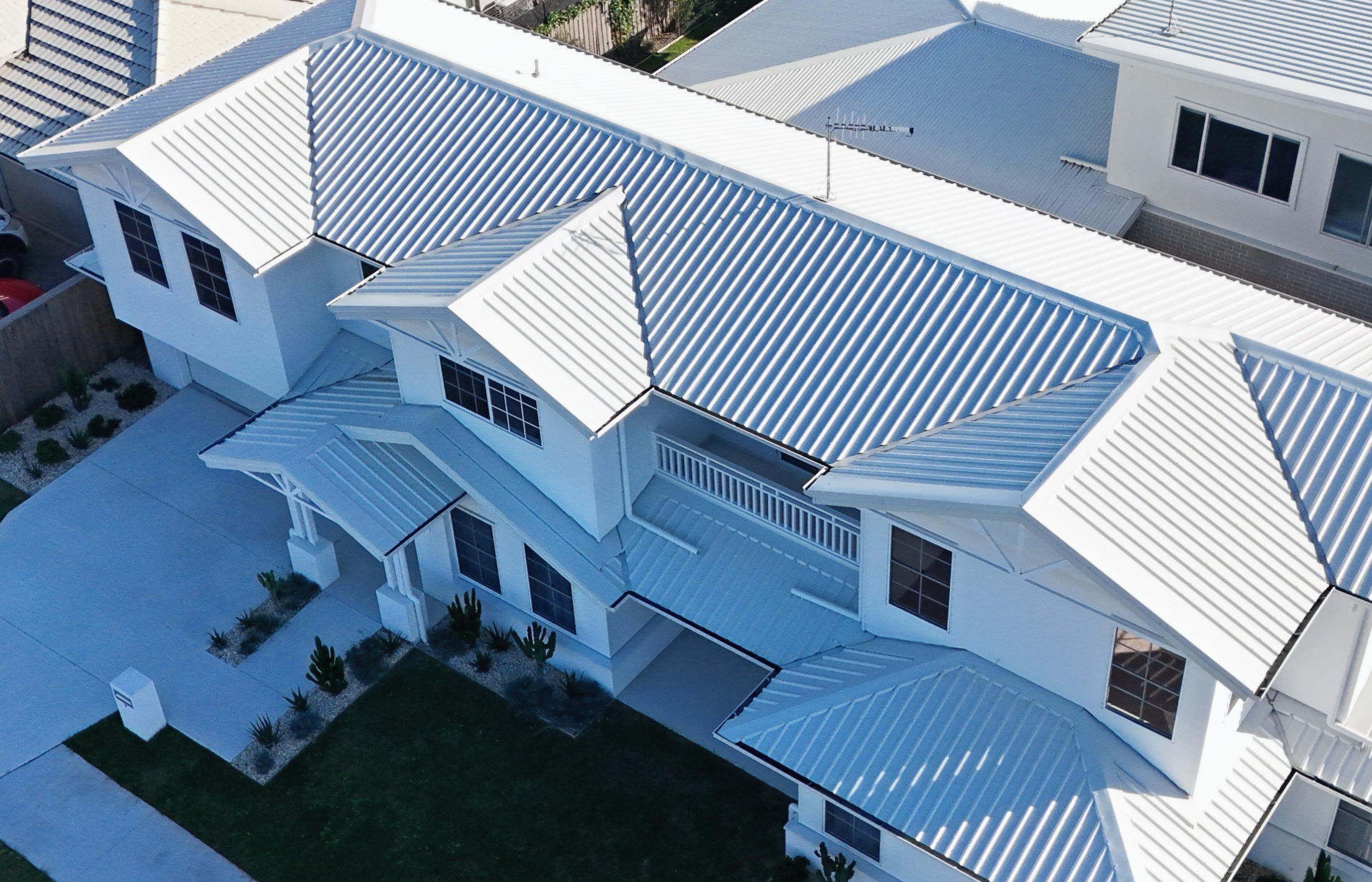
Modern Colorbond® steel is a different product. Lighter colours reflect more solar radiation, and the range includes heat-reflective technology aimed squarely at climates like ours. Paired with a proper insulation layer, a light-coloured metal roof performs well in a Brisbane summer.
Tiles have thermal mass, which means they absorb heat slowly and release it slowly — pleasant in the afternoon, less pleasant at 9pm when the roof space is still radiating the day back into your ceiling.
The honest answer: insulation matters more than material. Read our breakdown of Anticon versus sarking before assuming either roof will fix a hot upstairs bedroom.
Maintenance over twenty years
Tiles need their ridge capping re-bedded and re-pointed periodically, as the mortar weathers and cracks. Individual tiles get replaced as they break. Valleys silt up and rust out.
Metal roofs are lower-touch, but not zero-touch: fasteners and sealant around penetrations age, and any cut edge or scratch that reaches bare steel will eventually show corrosion, particularly near the coast.
Neither is maintenance-free. The difference is that tile maintenance is ongoing and incremental, while metal maintenance tends to be occasional and specific.
Cost
A like-for-like tile repair is cheap. A full tile-to-metal conversion is not — you are paying for tear-off, disposal, new battens and tie-downs where required, and the new roof itself.
Most standard Brisbane homes fall between $15,000 and $26,000 for a Colorbond® replacement, with the full range running from around $12,000 to $45,000+ depending on roof size, pitch, access, and whether structural work is needed. Our 2026 cost guide breaks that down properly.
The comparison that matters is not the quote against a repair. It is the quote against what you will spend maintaining a roof that is already at the end of its life.
Common questions
Is a metal roof noisier than tiles in rain?
It can be, but the gap is much smaller than people expect once insulation and sarking are installed. A modern metal roof over an insulated ceiling is not the tin shed people remember.
Can you put metal sheeting straight over existing tiles?
No. The tiles come off, the battens are inspected and replaced where needed, and new tie-downs are installed before sheeting goes on. Anyone offering to lay metal over tiles is skipping the part that keeps the roof on.
Does changing from tile to metal need council approval?
Sometimes. It depends on your council, whether your property sits in a character or heritage overlay, and what structural work is involved. See our guide on council approval for re-roofing in Queensland.
Talk to a licensed Brisbane roofer
Ascend Roofing Group is a family-owned, QBCC-licensed roofing business working across Brisbane, the Gold Coast, Logan, Ipswich and Moreton Bay. Free inspection, written quote, no obligation.
Get a free quote or call 0419 098 049.